Premium compact cameras occupy an interesting space in the camera market. They are small enough to carry almost anywhere, but unlike basic point-and-shoot cameras, they can offer large sensors, fast lenses, advanced autofocus and controls aimed at photographers who want more than a smartphone can provide.
For enthusiast photographers, that combination can be extremely appealing. You get much of the creative control of a mirrorless camera without having to carry a camera body and several lenses everywhere you go.
The best premium compact camera depends on what you value most. Some prioritize image quality, others offer a versatile zoom, while fixed-lens models can provide an exceptionally simple shooting experience.
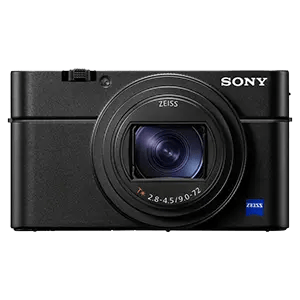
Sony RX100 VII

Fujifilm X100VI

Ricoh GR IV
Affiliate links
Sony RX100 VII

The Sony RX100 VII remains one of the most versatile choices for photographers who want serious capabilities in a genuinely compact body.
Its built-in zoom is one of its biggest advantages. Instead of being limited to one focal length, you can photograph wider scenes and then zoom in when a subject is farther away.
That makes it particularly useful for travel, family photography, street scenes and everyday shooting.
The camera also offers sophisticated autofocus, which is useful when photographing people or moving subjects. For enthusiasts who don’t want to carry interchangeable lenses, having this level of flexibility in a small body is a major benefit.
Photographers who want maximum versatility without changing lenses.
Compact body, useful zoom range, strong autofocus and capable photo and video performance.
Fujifilm X100VI

The Fujifilm X100VI takes a different approach.
Rather than trying to cover every focal length, it combines a high-resolution APS-C sensor with a fixed 23mm f/2 lens, equivalent to 35mm on a full-frame camera.
That focal length is particularly useful for street photography, portraits, travel and everyday photography.
The fixed lens also encourages a more deliberate approach. Instead of zooming from a distance, you have to think about your position and composition.
Fujifilm’s film simulations are another major attraction. They allow photographers to produce distinctive JPEG images directly from the camera, which can be useful when you want to spend less time editing.
Enthusiasts, street photographers and travelers who enjoy a fixed-lens shooting experience.
Large APS-C sensor, fast fixed lens, excellent image quality and distinctive JPEG color options.
Ricoh GR IV

The Ricoh GR IV is aimed at photographers who want maximum portability without giving up an APS-C sensor.
Its 18.3mm f/2.8 lens provides a 28mm-equivalent field of view, making it particularly well suited to street photography, travel and documentary-style shooting.
The camera is small enough to carry discreetly, which is one of its biggest strengths.
For photographers who spend hours walking through cities, markets and neighborhoods, that compact design can be more important than having a larger camera with interchangeable lenses.
The fixed lens does require a different way of shooting, but that’s part of the appeal.
Street photographers and enthusiasts who prioritize portability.
Extremely compact APS-C design, fast wide-angle lens and stabilization.
What Makes a Premium Compact Camera Different?
Premium compact cameras are more than simply small cameras.
They typically offer larger sensors than basic point-and-shoot models, better lenses, more manual controls and more advanced autofocus.
The important thing is that you don’t have to sacrifice portability to get those features.
For enthusiasts, a premium compact can make an excellent second camera. You might use a mirrorless system for planned shoots and keep the compact camera with you for everything else.
Fixed Lens or Zoom?
This is one of the biggest decisions you’ll need to make. Neither approach is inherently better.
Fixed lens
- A simpler, more focused shooting experience
- Ideal if you enjoy street photography
- Lets you work with one specific perspective
Zoom
- Considerably more flexibility
- Usually more convenient if you travel frequently
- Handles subjects you didn’t plan for
Sensor Size Matters
Premium compact cameras can use different sensor sizes, and that affects both image quality and camera design.
Larger sensors generally provide advantages in low-light shooting and depth-of-field control. However, a larger sensor can also require a larger lens and body.
That’s why some compact cameras use smaller sensors while offering impressive zoom ranges. The resulting camera may be much easier to carry.
Are Premium Compact Cameras Still Worth Buying?
For enthusiasts who value portability, absolutely.
A smartphone may be more convenient, but a premium compact camera provides physical controls, dedicated lenses, larger sensors and a more traditional photographic experience.
It can also encourage you to take photography more seriously without requiring a complete interchangeable-lens system. The key is choosing the right type of compact camera for your shooting style.
Which Premium Compact Camera Should You Choose?
An excellent choice for photographers who want maximum flexibility from a pocketable camera.
Particularly appealing if you enjoy street photography, fixed focal lengths and Fujifilm’s distinctive image rendering.
Ideal for enthusiasts who want an exceptionally portable APS-C camera for everyday and street photography.
Premium compact cameras aren’t designed to replace every mirrorless system. Instead, they offer something different: serious photographic capability that is small enough to take almost anywhere.
For an enthusiast photographer, that can be one of the most valuable features of all.
Sony RX100 VII
Fujifilm X100VI
Ricoh GR IV
Affiliate links
